
Most people who travel to Peru have heard of Machu Picchu, but they aren’t always sure where it is or what surrounds it. Cusco—also known as Qosqo—is the gateway to this iconic site, but what many travelers don’t realize is that the city itself holds incredible value. In fact, one of the things you probably didn’t know about Cusco is that it’s not just a stop along the way, but a destination rich in culture, history, and tradition. When people overlook that, they miss out on what truly makes it special.
“Qosqo” or Cusco: Its True Meaning Goes Beyond the “center of the world”
When people hear “Cusco,” they almost reflexively think of Machu Picchu—or that phrase you see everywhere: “the navel of the world.” It sounds exotic, even mystical. But if you pause for a moment and look beyond what the brochures say, you’ll discover that the city’s true name is “Qosqo,” and it holds a much deeper history.
For the Incas, Qosqo was the center of the Andean universe—not just because of its location, but because the entire empire was organized from there. It was the meeting point between the sacred and the earthly, the place where the roads to the four suyus (regions of the Tawantinsuyu) began, and where everything had order, purpose, and a connection to the cosmos.
Calling it the “center of the world” is a Western way of interpreting it. For the Andean worldview, however, Qosqo was more of a spiritual axis—a heart that beat in rhythm with the apus (sacred mountains), the stars, and the will of the people. Its urban layout, temples, and even its rituals were all aligned with this idea of a cosmic center.
Cusco Was Designed in the Shape of a Puma, the Sacred Animal of the Incas
One of the most striking and meaningful ideas about Cusco—one that many people are unaware of—is that the ancient Incas designed the city in the shape of a puma (Puma concolor). But don’t be misled: it’s not as if you can see a perfectly outlined puma from above, like a literal drawing. Instead, it’s a symbolic design, based on how the Incas understood and shaped space.
In Inca thought, the puma represented the earthly plane—everything that can be perceived through the senses and that requires balance to remain in harmony. It’s no coincidence that they chose this animal as the symbolic foundation for designing their capital. According to this worldview, the puma’s head was located in the area of Sacsayhuamán, the massive fortress that still towers over the city today. The body extended through what is now the historic center, reaching into the city’s oldest neighborhoods, while the tail aligned with the spot where two rivers meet just south of Cusco.

Learn more about the sacred animals of the Incas here|The Three Sacred Animals in Inca Tradition
The Tahuantinsuyu Flag: Its Real Origins and What It Truly Represents
Many visitors assume that the colorful rainbow flag flying over Cusco is the original banner of the Inca Empire. At first glance, it makes sense—it looks ancient and vibrant, with its seven colors often linked to nature and the Andean world. But the real story is much more recent—and a bit surprising.
Although it’s widely associated with the Inca Empire today, there’s no evidence that the flag existed in Inca times. There’s no historical record, colonial chronicle, or archaeological evidence confirming that this symbol existed during the empire’s time. In fact, the version seen today in plazas, parades, and souvenir shops was introduced in the 1970s by the mayor of Cusco, who wanted to reinforce the city’s cultural identity.
So why a rainbow?
Because the rainbow has long held symbolic meaning in Andean cultures—it’s tied to ideas like balance, fertility, and divine presence. So even though it’s not a true relic of the Inca past, the flag has come to represent cultural pride and resistance for many in Cusco today.

There’s one more twist: the rainbow flag is also globally recognized as a symbol of the LGBTQ+ movement. This overlap has led to confusion, especially among tourists unfamiliar with local traditions. But in Cusco, the meaning is different—it’s not about sexual identity, but rather a reassertion of Andean heritage.
Cusco Hides Mysterious Underground Tunnels Beneath Its Streets
Behind its cobblestone alleys and colonial facades, Cusco conceals a hidden world: an underground network of tunnels that has sparked myths and speculation for generations. Most visitors walk the streets unaware that beneath them lies a system of passageways said to connect ancient temples, fortresses, and even natural caves—some believed to predate the Inca Empire.
One of the most talked-about entry points is the Temple of Qoricancha, once the spiritual heart of the Inca world. According to local legends, tunnels beneath it stretch all the way to Sacsayhuamán, several kilometers uphill. More adventurous versions claim they extend as far as Ollantaytambo or Písac—though no scientific evidence supports this.

During colonial times, many of these entrances were blocked—either out of fear, superstition, or an attempt to hide what lay within. Today, a few small sections are open to the public, but most remain inaccessible or unexplored due to safety concerns. What we do know is that these tunnels are real—and the mystery around their purpose still stirs the imagination: were they escape routes, ritual pathways, or part of a hidden communication system?
In Cusco, the Sun Still Connects with Inca Architecture
In Cusco, nothing was left to chance—not even how the buildings were placed. Many Inca temples, streets, and structures were designed to line up with the rising or setting sun, particularly during key moments like the solstices and equinoxes.
Why was this important? Because for the Incas, the sun wasn’t just a source of light—it was a timekeeper. The rhythm of their lives—festivals, agriculture, and ceremonies—was deeply connected to its path across the sky.
Take Inti Raymi, for example: this grand festival marked the beginning of the new solar cycle. To determine the exact day, they watched where the sun appeared over the mountains or behind specific temples.
What’s amazing is that these alignments still work. On certain days of the year, if you stand in just the right spot, you can watch the sunlight travel through ancient doorways or corridors with stunning accuracy.
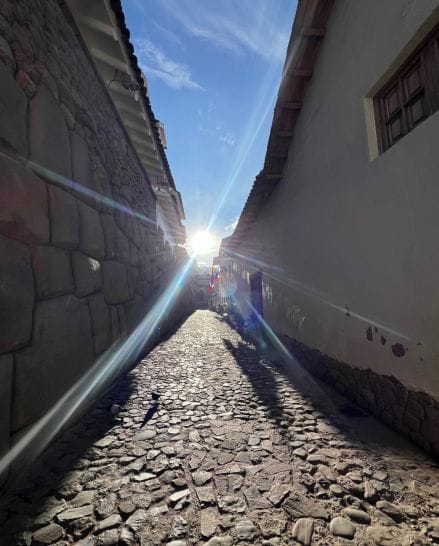 Sunrise over Triunfo Street in Cusco, where the morning light aligns perfectly with Inca stone walls.
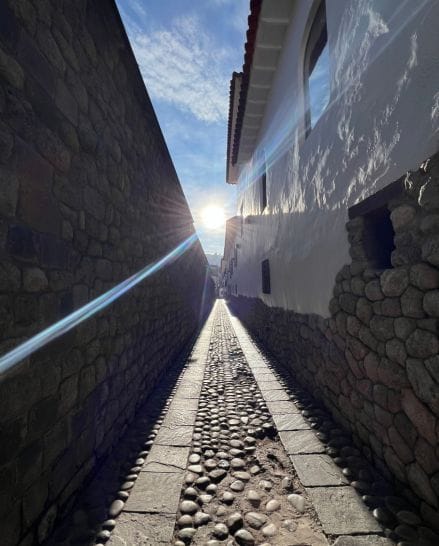 Early morning light on Santa Monica Street, highlighting the precision of Inca urban design in Cusco.
You Can Still Visit Huacas in Cusco and Feel Their Spiritual Presence
Something few travelers realize is that Cusco still holds huacas—ancestral sacred sites where the Incas once gathered to honor the forces of nature and the gods. During the colonial period, many of these places were hidden or destroyed as part of efforts to erase native beliefs, but some survived quietly, protected by the landscape and the people who never stopped believing.
These places aren’t marked on tourist brochures, and you won’t find signs pointing the way. But they’re still there—alive in the stories of the locals and the quiet rituals that happen when no one’s watching.
One of the most accessible huacas lies just a short walk from San Blas Square. You might not even notice it at first, but if you go with respect and open eyes, you might witness someone leaving an offering, whispering a prayer, or simply connecting with something deeper—something that has never fully disappeared.
In Cusco, Coca Tea and Leaf Chewing Are Everyday Traditions with Ancient Roots
Walk through Cusco, and you’ll likely spot someone sipping coca tea or tucking a few leaves into their cheek. To the casual traveler, this might seem like a quirky local custom—or a natural remedy for altitude sickness. But for the Andean people, it’s something much deeper.
Coca leaves (Erythroxylum coca) have been revered for centuries. They played a vital role in spiritual ceremonies, offerings to Pachamama (Mother Earth), and moments of reflection and labor. The act of chewing coca—called acullir—isn’t just about getting an energy boost. It’s a meaningful gesture, tied to cultural identity and a way of staying in rhythm with the natural world.

Today, that connection is still alive. Market vendors, farmers, and mountain guides alike often keep a pouch of leaves with them—not for show, but because it’s part of how they live and relate to their land. Coca tea, while a gentler and more tourist-friendly version, still honors the same tradition: easing the body’s adjustment to the high altitude and reinforcing the link between humans and the mountains.
Guinea Pig Is a Traditional Dish in Cusco and It Has a Deeper Cultural Role
For many first-time visitors, seeing a whole guinea pig served on a plate can be surprising—especially for those who see it as a household pet back home. But here in Cusco, this small animal has long held cultural significance that goes far beyond the dinner table.

Long before the Incas, guinea pigs were already part of Andean life. Their presence can still be found in ancient pottery, weavings, and accounts of spiritual ceremonies. Rather than everyday food, they were considered a special meal, reserved for meaningful dates or offered in honor of the gods.
That tradition continues today. During major festivals like Corpus Christi, local carnivals, or religious celebrations, guinea pig (known as cuy) takes center stage on the table. It’s typically roasted, fried, or cooked on a spit, and served with native potatoes, roasted corn, and a spicy ají sauce—bringing together flavors that have been part of the region for generations.
Cusco Has Only Two Seasons: Dry and Rainy and They Matter More Than You Think
In Cusco, forget about the classic four seasons. Here, the year is split into just two: the dry season and the rainy season. Knowing the difference isn’t just helpful—it can totally change how you experience the region.
From May to September, the dry season takes over. Days are sunny, the skies are crisp and blue, and the nights can get seriously cold. It’s the best window for travelers who want to hike, explore Machu Picchu, or visit the Sacred Valley without weather interruptions. Just don’t forget your jacket—the mornings can feel like winter even if the sun’s out by noon.
Then comes the rainy season, roughly from October to April. Showers can happen at any time, turning trails muddy and rivers lively. But it’s not all bad news: the mountains look greener than ever, crowds thin out, and prices tend to ease up. For those willing to adapt, it can be a beautiful (and quieter) time to visit.
Quechua Is Still Spoken in Cusco and It’s More Alive Than You Think
While most people in Cusco speak Spanish, Quechua is far from forgotten. You’ll still hear it in everyday conversations, especially in nearby villages, markets, and among families who’ve spoken it for generations. In fact, don’t be surprised if someone greets you in Spanish but switches to Quechua to say something heartfelt or funny—it’s part of the cultural rhythm here.
What’s beautiful is that Quechua isn’t just something from museums or history books. It lives on in music, local radio, school lessons in the countryside, and even TikToks and Instagram reels made by proud young speakers.
For a long time, many were made to feel ashamed of speaking Quechua. That’s changing. Today, more and more young people are bringing it back with pride—treating it not just as a language, but as a symbol of strength, identity, and belonging.
Things to Keep in Mind When Planning Your Trip to Cusco
Now that you’ve uncovered some fascinating things about Cusco, there are a few practical tips that can make the difference between just an okay trip and one you’ll never forget. Here are Four key things about Cusco most first-time visitors overlook:
Acclimatization is a must if you don’t want the altitude to ruin your plans
Cusco sits at over 3,300 meters (about 11,000 feet) above sea level, and that means your body will need a little time to catch up. The infamous “soroche” (altitude sickness) can hit you with headaches, fatigue, and even nausea—especially if you jump straight into exploring without a break.
Here’s the best advice: take it slow on day one. Stay hydrated, eat light meals, and avoid heavy physical activity right after you land. A warm cup of coca tea (a local staple) can help, and a short nap doesn’t hurt either. If you let your body adjust properly, you’ll enjoy everything Cusco has to offer a whole lot more.
If you plan to visit Cusco’s archaeological sites, you’ll need a special pass (Cusco Tourist Ticket)
One of the most common mistakes first-time visitors make is assuming they can just pay at the gate to enter any archaeological site. But that’s not how it works. Many of the city’s most important ruins—like Sacsayhuamán, Qenqo, and Tambomachay—are grouped under a single access system called the Cusco Tourist Ticket.
This ticket gives you bundled access to multiple sites, and there are several versions depending on how much time you have and what you’re interested in seeing. It’s something you’ll want to sort out early on, since many guided tours require it—and they don’t always tell you that upfront.
Learn more about the Cusco Tourist Ticket here.|Cusco Tourist Ticket Explained (Boleto Turístico)
Machu Picchu isn’t actually in the city of Cusco
Many people mistakenly believe that Machu Picchu is actually in Cusco, but it’s located several hours away from the city. While both are in the same region, visiting Machu Picchu requires a separate journey outside the city.
Being in Cusco—the capital of the Inca Empire—is just the first step. To reach Machu Picchu, you’ll first need to travel to the Sacred Valley, with Ollantaytambo or Hidroeléctrica being the most common departure points. From there, you continue on to Machu Picchu Town (formerly known as Aguas Calientes), a small village located at the base of the mountain that holds the famous Inca citadel.
From town, you can either hike up the mountain or take a bus to the entrance of the sanctuary. The whole trip takes several hours, so it’s important to plan ahead and allow enough time.
Machu Picchu Tickets Sell Out Fast – Plan Ahead
One of the most common mistakes travelers make is assuming they can buy a ticket to Machu Picchu once they arrive in Cusco. Unfortunately, it’s not that simple. The site enforces a strict daily visitor limit, and during peak travel seasons, tickets can sell out weeks in advance.
If you already have your travel dates set, don’t wait — book your tickets as early as possible. This is especially important if you plan to hike Huayna Picchu or Machu Picchu Mountain, as access to those trails is even more limited.
Pro tip:|Tickets aren’t sold at the entrance gate. You’ll need to purchase them online or at official ticket offices in Cusco or Aguas Calientes (Pueblo Machu Picchu). Arriving without a ticket could mean missing out on one of South America’s most iconic sites.
Related Posts
June Festivals in Cusco: Inti Raymi, Corpus Christi and Qoyllur Rit’i
Cusco vs Arequipa: Which Peruvian City Should You Visit First?
Top Day Trips & Easy Tours from Cusco (No Long Hikes Required)
The Most Instagrammable Spots in Cusco
The Most Important Festivities in Cusco