
Imagine a landscape where the earth is covered in reddish hues, as if the sun had painted the mountains with its last breath. A place where silence is only interrupted by the wind and the gaze of the Apus, the ancient Andean guardians, seems to follow each of your steps. That is the Red Valley of Peru, a little-explored destination that hides secrets in its scarlet slopes, faces carved by nature, and a river that, at certain times of the year, flows as if carrying the blood of the mountain itself. But the Red Valley is not just a visual spectacle; it is a place where history, geology, and the Andean worldview intertwine in a mystery yet to be discovered. Dare to walk among giants and unravel their secrets?
History: The Creation of the Apus
The mountains of the Andes are not mere rock formations; for the native peoples, they are sacred beings known as Apus. According to the Andean worldview, these Apus were created by Wiracocha, the supreme deity, to protect humans and maintain the balance between heaven and earth. It is said that the Apus have the power to grant blessings or punish those who travel through their domains. Apu Ausangate, the most imposing in the region, is considered the guardian of the various destinations visited today, such as the Red Valley, the Rainbow Mountains, and all the places that seem like divine works.
What is the Red Valley?
The Red Valley is a tourist destination in the Peruvian Andes. It is a vast area covered by mountains and valleys tinged with deep red, the result of the high concentration of iron oxides in the soil. Unlike the famous Rainbow Mountain, the Red Valley offers a monochromatic spectacle where the intensity of the color changes with the sunlight. What we mean is that the more sun there is, the more beautiful the color of the valley will be; however, if it is cloudy, we will see somewhat duller colors.
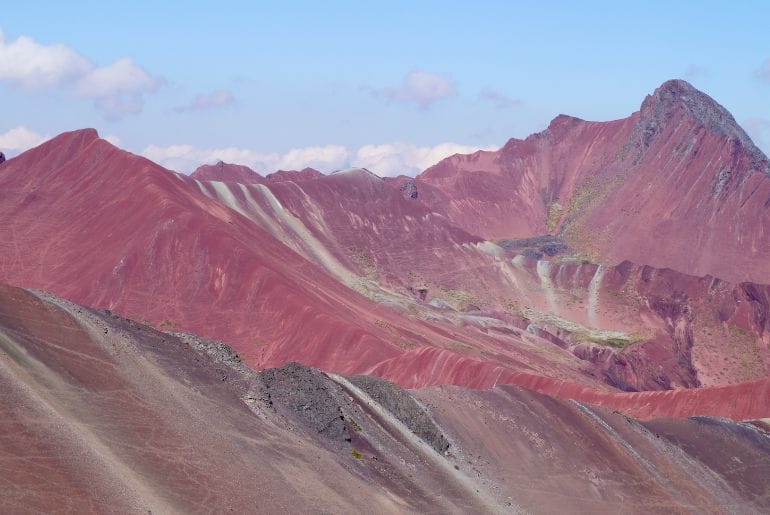
The Faces Formed in the Mountains of the Red Valley
Due to erosion and the arrangement of rocks, some slopes seem to be sculpted with human figures that silently watch over travelers. These formations have been interpreted by locals as the faces of the Apus, watching the passage of those who venture into their territory. Some say that these faces change expression depending on the time of day and the sunlight, a mystery that continues to amaze visitors.
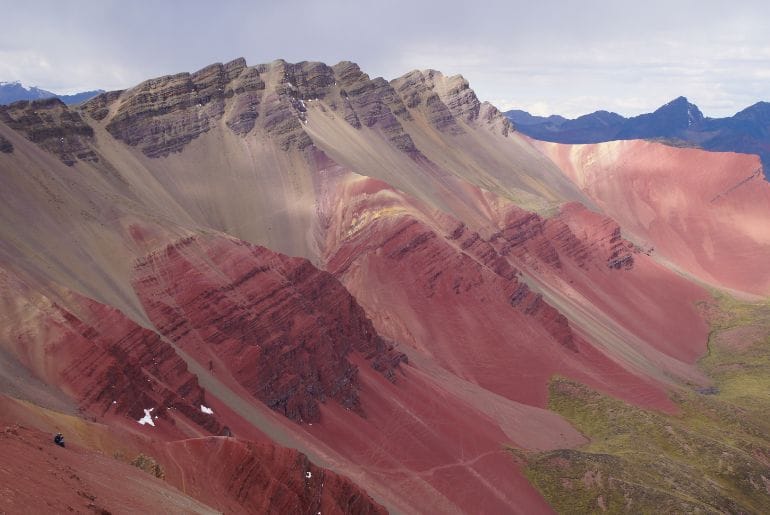
Location and Height of the Red Valley
The Red Valley is located in the Cusco region, within the Canchis province, in the Pitumarca district. It sits at an impressive altitude of 5,200 meters above sea level, making it one of the highest and most challenging points in the area, along with the Rainbow Mountain. From its peaks, you can admire the majestic Ausangate snow-capped mountain in all its glory.
When Was It Discovered?
Unlike Machu Picchu, which has been explored and documented for decades, the Red Valley remained hidden from tourism until just a few years ago. It was primarily discovered by the local communities living near the Red Valley, who already knew of its existence, and later by travelers and local guides who, while exploring new routes in the region, stumbled upon this little-known geological marvel.
Paths or Routes to Reach the Red Valley
There are different ways to reach the Red Valley, but most travelers visit it as an extension of the hike to the Rainbow Mountain. From Cusco, transportation is taken to Pitumarca or Cusipata, and then a hike of about an hour and a half begins. Additionally, for the more adventurous, there is an alternative route from Chillihuani, less traveled but offering spectacular landscapes.
Its Connection with the Rainbow Mountain: Vinicunca and Wilcacunca
The Red Valley is not isolated; it is part of the same geological system as Vinicunca, the Rainbow Mountain, and another colorful mountain called Wilcacunca. All these places share a similar geological history: millions of years of mineral sedimentation gave rise to their unique colors. However, while Vinicunca exhibits multicolored stripes, Wilcacunca showcases more than three colored mountains, and the Red Valley is dominated by the color red, making it even more special within the same ecosystem.
Its Connection with the Red River
This Red river takes on an intense red color due to the erosion of minerals from the surrounding mountains and the seasonal rains that carry sediments. Its appearance is so striking that many compare it to a river of blood flowing through the valley. This phenomenon, although brief, shows how the Andes continue to transform and reveal new landscapes to those who know how to observe.